
Thinking through lesson planning so that it works for you instead of being work for you!
How to Lesson Plan
Do you need a lesson plan template? Canva, Teachers Pay Teachers, and Pinterest would be a great place to get inspiration or support other teachers and creators!
Lesson planning can be so daunting. It can be pages of details or fit on a sticky note.
Depending on what your school requires you can adjust these steps to fit your needs. There are so many different methods and strategies.
I teach high school math with 3 different preps. My lesson planning is going to look very different from an elementary teacher’s.
As I show my planning steps if you see that they couldn’t be adapted to your situation, I have linked other videos or resources for you to check out that might help.
Is digital lesson planning something you prefer? Check out this video from Pocketful of Primary.
We Are Teachers has a great article that features lesson planning inspiration as well as specific lesson plan examples for all levels of content. Check out their article here.
Step 1:
You need a lesson plan book.
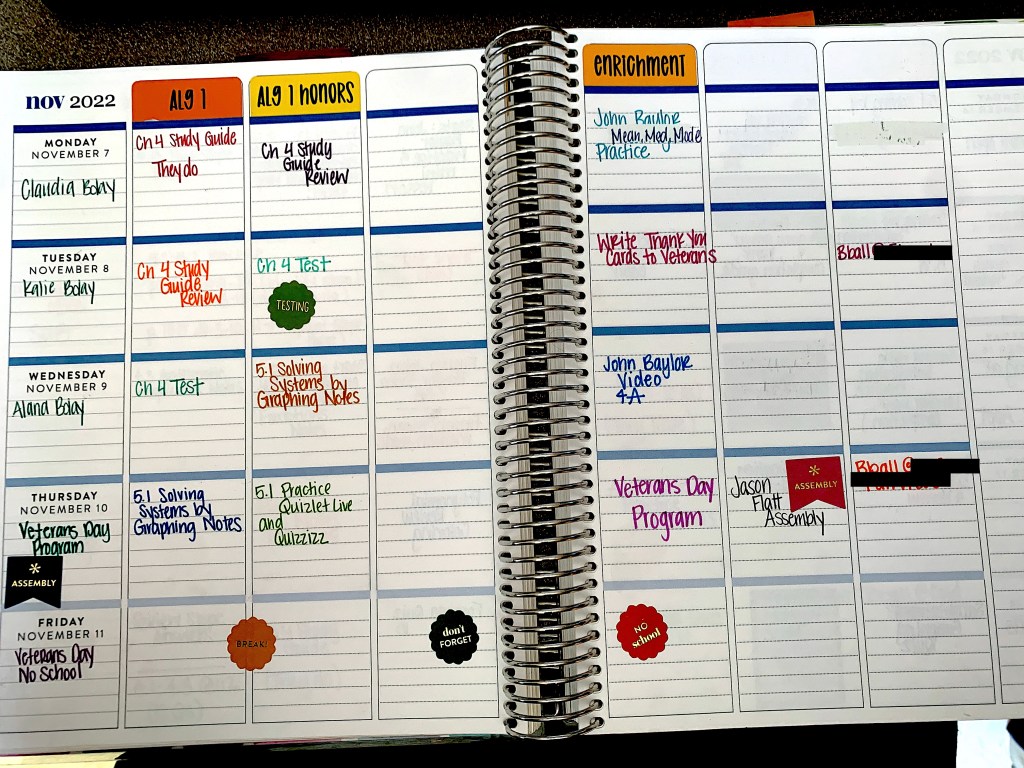
You can do something pretty basic and old school, digital or a fancy paper planner. I have tried all three and I prefer to go the fancy paper planner route.
My preferred lesson plan book is the Erin Condren Teacher Planner. You can order stickers for your headings or you can write them yourself. There will be a later blog post detailing how I maximize my Erin Condren Planner.
I have also thought about trying the Happy Planner, but I am hesitant. Later blog post comparing the two? Let me know in the suggest a blog button!
Hint: The thought of scribbles and markings all over my book stresses me out. Anyone else? I prefer to plan out my lesson with small sticky notes that can be easily moved up or down and then once a lesson is finished, I will write in my pretty pens what we actually did that day.
Step 2: Start with the big picture.
When it comes to lesson planning, I find it easiest to start with the big picture and get more focused as the process continues.
Entire Course Length
Whether your course is one semester or an entire school year, start with ALL the content you must cover.
Most districts have a pacing guide they want you to use. Whether its a strict requirement or a suggestion just depends on your district. Most instructional or curriculum leaders will have this pacing guide.
Read through it and see the overview of the course and how the chapters flow into one another.
Getting an idea of what students should know from previous chapters and where they will end up going throughout the course will help you better prepare them as you get more detailed with your plans.
Quarterly
Review the pacing guide to see what you need to teach each quarter.
If looking at the entire year is very overwhelming for you, then just take it a quarter at a time. Read through the chapters you need to complete each quarter to stay on track.
A little ahead or behind? Don’t stress. You can always adjust your future lessons to make up for lost time or throw in some enrichment lessons.
Planning for the quarter helps you stay on schedule [or at least close to on schedule] for the rest of the year.
Step 3: More Detailed
Chapters
Plan with the end in mind.
Sometimes it can be helpful to flip to the end of the chapter and see what students should be able to do when the chapter is over.
Once you have an idea of the end goal, look through each section in the chapter and take note of the big concepts.
Whether you teach from the textbook, use lessons of Teachers Pay Teachers or like to create your own lessons – remember that your district has their curriculum they want you to use. While adapting it to fit the needs of your students is necessary, it should resemble the curriculum provided for you.
When I plan for a chapter I normally follow this pattern:
1-2 Lessons (guided notes/examples), 1 practice day for independent or partner work, 1-2 Lessons (guided notes/examples), 1 practice day for independent or partner work, midway through the chapter I will do a quiz on the content covered so far, 1-2 Lessons (guided notes/examples), 1 practice day for independent or partner work, 1-2 Lessons (guided notes/examples), 1 practice day for independent or partner work, (repeat until chapter is complete), students complete the study guide for their test, we review the study guide as a whole class and finally they take a chapter test.
This step is where my sticky notes come in.
I lay out the pattern throughout my lesson plan book.
At this point if you have a test scheduled for a Monday or a conflict with a school event, don’t stress.
When you get to the weekly planning you can adjust and make lesson changes as necessary.
Weekly
At this point you have done a lot of the prep work. Take it a week at a time to feel prepared, but not over stressed.
I try to avoid giving tests on Mondays, but sometimes it can’t be helped. Some teachers might have extra classes on certain days that they need to plan around or have a substitute.
Keep all of these obstacles in mind as you plan out your week.
Daily
We all know that kids thrive off routines.
They are relaxed because they know what is coming and what the routine is each day.
For example, each day in my classroom we follow the same routine:
- Students complete a bell ringer while I am taking attendance
- I pass back papers I have graded from the day before
- I pass out any papers the students might need for the lesson
- Some kind of formative assessment to end the lesson
By having this routine everyday it makes it easier to plan lessons too.
I know what I need for each lesson. Even though some days are different, I always have a general idea of the flow of the class.
Formal Lesson Plans
Look. Formal lesson plans with 100 details of how, when, why, etc. have their time and their place.
However, they are not realistic for teaching every single day.
Have a template laid out for yourself that you can just adapt as you need to.
Has anyone ever actually read those 10 page lesson plans? Absolutely not.
Should you have them ready or be able to describe what you are going to do for your lessons for the next few days? Yes.
Conclusion
Lesson plans are crucial for being a prepared and organized teacher.
Sometimes we have to wing it, but it is never ideal.
By having a plan and an outline, you can focus on what you need copies of and what you still need to prepare for your students.
Takeaways
- Have a go to planner – whichever type you prefer
- Start with the big picture and get more and more detailed from there.
- Have a plan, be prepared, but also be flexible.
- Classroom routines and lesson plans are meant to make your life easier, not more difficult.
- Find what works for you and use it to make your day easier while also maximizing the learning time your students have with you.
Need more inspiration for high school lesson planning? Here is an ELA example from one of my favorite teacher Youtubers!
 Just a Teacher Blog
Leave a comment