
What is a formative assessment?
Formative assessments can change your teaching when used effectively. These assessments are tools that are used to guide your teaching.
How do you know if your lesson was effective if you don’t assess the students?
Formative assessments don’t have to be a burden, they don’t have to add to your workload. If you use them wisely they can actually minimize your workload.
Should they be taken as grades?
Ultimately it is a personal decision whether or not you want to take them for a grade.
Consider whether they will reflect on the students ability or if it is just practice. Also consider whether your admin requires a minimum number of grades per work. These can help you reach those numbers without adding to your workload.
Some of the assessments mentioned have no grading required! Remember that the more you assign work to grade, the more work you have to do to enter those grades.
Make decisions that are best for your students, but don’t end up as a pile of papers on your desk.
Why do you need them?
Imagine pouring your heart into a lesson, the students look like they are understanding and then you get to the chapter test and everyone flunks it.
How does that happen? Students are great actors.
Just because it looks like they are getting it, doesn’t mean they are. Maybe some of them are getting most of the content, but have a few minor misconceptions.
How can we fix those misconceptions before it becomes something they learn incorrectly? Formative assessments.
While most lessons should be planned out for the future, they are always going to be adjustments to make. Formative assessments can tell you where those adjustments need to be and where you can move more quickly.
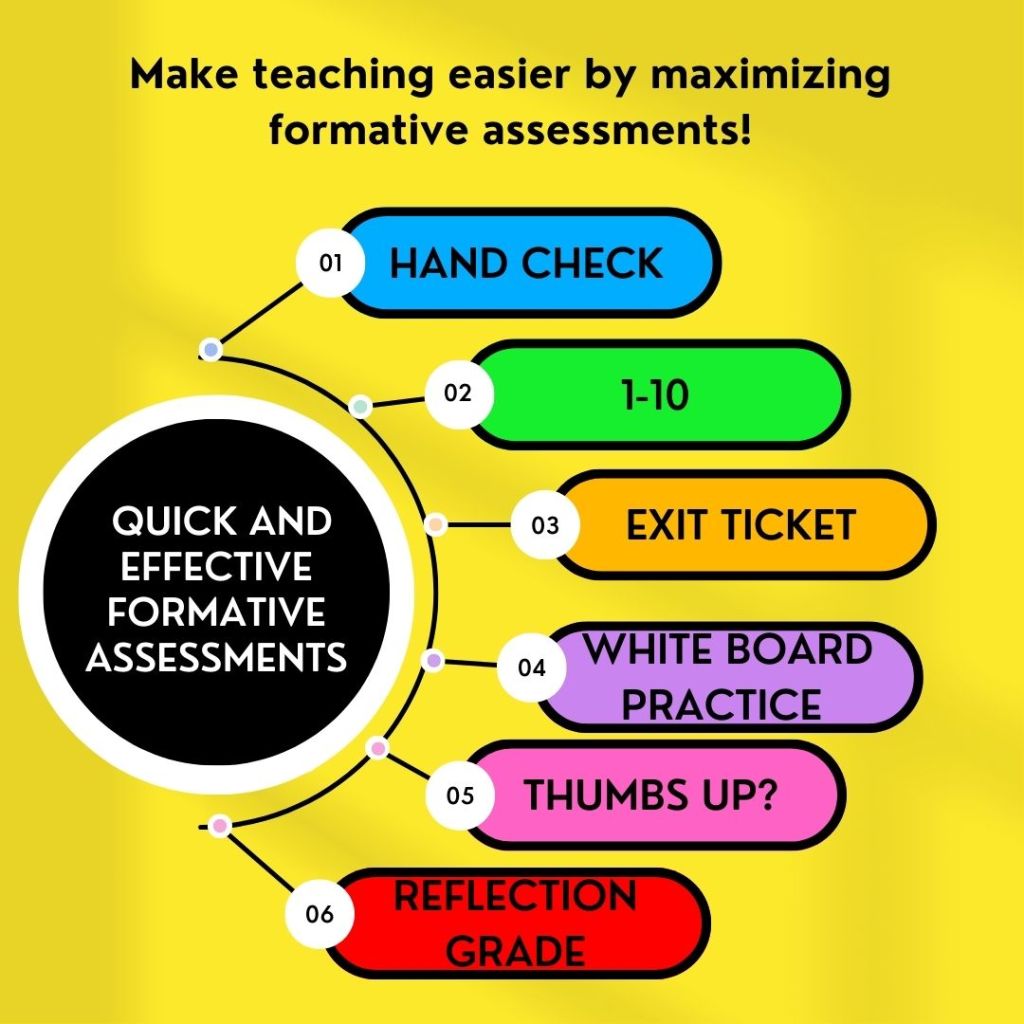
6 Go to Formative Assessments

- Hand Check
This is a favorite formative assessment when time is short and it doesn’t require grading. It can take less than a minute and let’s face it, when that bell is about to ring they are going to hit that door in a matter of seconds.
Tell students that you want them to show you how they feel about the content using their fingers. 1 – students have no idea what you have been saying for the last 45 minutes and 5 – students could take a test on the content right now.
Based on the overall feel of the room, decisions about moving forward or reteaching can be made.
- 1-10
This one is nice when you have different kinds of questions on the content.
Ask students to rank each question from 1-10 based on what they understand and what they don’t. 1 – struggling a lot and 10 – very confident.
Another no grading required option!
- Exit Ticket (1-2 problems)
Exit tickets can be done on paper, flashcards or on the students notes.
Choose 1-2 problems to check based on the lesson and have them turn it in before they leave the classroom for the day.
This is a great choice because
- you can take it for a grade if you want to or you can just give a checkmark or an x
- it helps you identify misconceptions and identify exactly where students are misunderstanding something
- the papers can easily be sorted into piles of mastery, needs work or needs intervention
- White Board Practice
For a review that doesn’t require much prep or grading, white board practice is a perfect assessment. It does require you to have the materials: whiteboard, marker and eraser.
Give students a question, allow them an appropriate amount of time to answer and then have them all turn their white boards around so you can see their response.
This is great for a review with multiple questions too.
Being able to see all of the answers from everyone is the class at the same time can be really helpful in finding incorrect wrong answers or points of confusion.
These could easily be turned into a group game or point system too.
- Thumps Up?
Why is thumbs up a question?
This formative assessment limits students to 3 choices. Thumps Up – I got this! Thumbs to the side – I get some of this. Thumbs down – I don’t get this at all.
This is another no grading and time sensitive assessment.
- Reflection Grade
If you have never done this before, it is very interesting.
On test day, before students begin their test – have them write down at the top of their paper what they THINK they are going to make on the quiz.
It is surprising how accurate they can be at predicting their grade. This could be modified for practice assignments too.
Another way to do this is to have students circle questions that think they got correct and ones they think they will miss.
Conclusion
I know that this is going to sound crazy and some teachers are going to call me crazy…. But I have never given homework.
I use formative assessments so often throughout my teaching and class time that I always have a good idea of what my students are mastering and what they are struggling with.
This next statement might ruffle some feathers…… but y’all know they just copy each other’s homework right? I know that if they want to cheat, then they will.
However, it is much harder to cheat while in my classroom and while their peers are doing the same problems at the same time.
 Just a Teacher Blog
Leave a comment